When selecting fabrics for professional workwear, buyers increasingly face a choice between recycled polyester and virgin polyester. Both materials can be used for jackets, shirts, polo shirts, vests, bodywarmers, and trousers, but they differ in raw-material sourcing, sustainability positioning, supply considerations, and sometimes cost.
For companies sourcing China workwear, the decision should not be based simply on whether recycled polyester is more expensive. The more useful question is whether rPET can provide the required garment performance while meeting the buyer's sustainability objectives.
This guide compares rPET and virgin polyester across cost, durability, breathability, weather protection, comfort, and practical workwear applications.
Virgin polyester is manufactured from newly produced petrochemical feedstocks, while rPET is produced by processing existing PET materials into recycled polyester.
According to Textile Exchange's 2025 Materials Market Report, polyester remained the world's most widely produced fiber in 2024, accounting for about 59% of global fiber production. Recycled polyester production increased from approximately 8.9 million tonnes in 2023 to 9.3 million tonnes in 2024, although virgin polyester production increased more rapidly.
The basic polymer family is still polyester. The main difference is where the feedstock comes from.
Factor | rPET | Virgin Polyester |
Feedstock | Recycled PET materials | New petrochemical feedstock |
Recycled content | Yes | No |
Performance potential | High | High |
Sustainability positioning | Stronger | Conventional |
Typical cost | May be higher or more variable | Often more price competitive |
Supply considerations | Depends on recycled feedstock | Highly established supply |
Workwear applications | Jackets, shirts, vests, trousers | Jackets, shirts, vests, trousers |
Certification options | GRS/RCS and other programs | Product-specific certifications |
This means that choosing rPET does not automatically mean choosing a lower-performance material.
Virgin polyester has a highly established global supply chain, which can make it commercially competitive, especially for large-volume standard fabrics.
rPET can involve additional collection, sorting, cleaning, processing, quality control, and traceability. If certified recycled content is required, there may also be additional certification and supply-chain management costs.
Textile Exchange has noted that recycled polyester continues to face competition from relatively low-cost virgin fossil-based polyester.
However, fabric price should not be evaluated separately from the finished garment.
For example, a recycled polyester polo shirt may cost more per unit than a conventional polyester shirt, but it may help a buyer satisfy a customer's recycled-content procurement requirement. Likewise, a recycled jacket may carry additional material value while supporting a sustainability-focused product range.
For bulk workwear, the most useful calculation is therefore total garment cost versus required performance and purchasing objectives, rather than simply comparing fabric prices.
In many applications, properly manufactured rPET can provide performance comparable to virgin polyester.
However, the performance of a garment depends on much more than the origin of the polyester fiber.
Important variables include:
Fiber and yarn quality
Fabric construction
Fabric weight
Knitting or weaving structure
Finishing treatment
Membrane technology
Insulation
Seam construction
Reflective-material design
Garment pattern
This is why buyers should compare complete fabric specifications rather than assume that recycled polyester is automatically weaker or stronger than virgin polyester.
For example, Kachun's recycled high-performance softshell jacket uses a three-layer structure consisting of a 100% recycled polyester outer shell, polyester fleece, and a waterproof and breathable TPU membrane.
The construction is designed to provide durability, breathability, wind resistance, water resistance, and warmth. The product is also specified to EN ISO 20471 Class 3, ANSI/ISEA-107 Type R/Class 3, and GRS.
Jackets are one of the most demanding workwear applications because they may need to provide weather protection while maintaining visibility, mobility, and comfort.
A Recycled polyester rain jacket can use recycled polyester as its shell while relying on a membrane or coating to provide waterproof and breathable performance.
It uses 100% recycled polyester woven pongee with a three-layer waterproof and breathable TPU membrane. It also features taped seams, insulation, waterproof zippers, a detachable hood, and segmented reflective tape.
For buyers comparing a polyester rain jacket waterproof design with a conventional polyester jacket, the important point is that waterproof performance depends primarily on the overall construction.
An oxford waterproof shell jacket, for example, can combine Oxford fabric with a coating or membrane, but “Oxford polyester” alone does not define the final waterproof performance.
ISO 811:2018 specifies a hydrostatic pressure method for determining the resistance of textile fabrics to water penetration.
Softshell garments provide another useful comparison because they combine several performance requirements.
A Hi-Vis softshell work jacket may need stretch, breathability, wind resistance, water resistance, and high visibility.
Kachun's conventional HI-VIS Softshell Jacket uses 100% stretch polyester softshell with a waterproof and breathable TPU membrane.
Its recycled high-performance softshell uses recycled polyester for the shell while retaining a three-layer construction with fleece and a TPU membrane.
This demonstrates that recycled and virgin polyester can be used for similar technical garment structures.
For buyers searching for soft shell Hi-Vis jackets, the more important questions are:
What is the fabric weight?
Is the fabric stretchable?
What membrane is used?
Is it waterproof or only water resistant?
Is it breathable?
What reflective tape is applied?
Does the finished garment meet the required safety standard?
ASTM D737-18(2023) provides a standardized method for measuring textile air permeability. The standard notes that air permeability can be relevant to the performance of weather-resistant and rainproof fabrics.
Shirts and polo shirts have different priorities from outerwear. Lightweight construction, moisture management, breathability, and freedom of movement are often more important than heavy insulation or waterproofing.
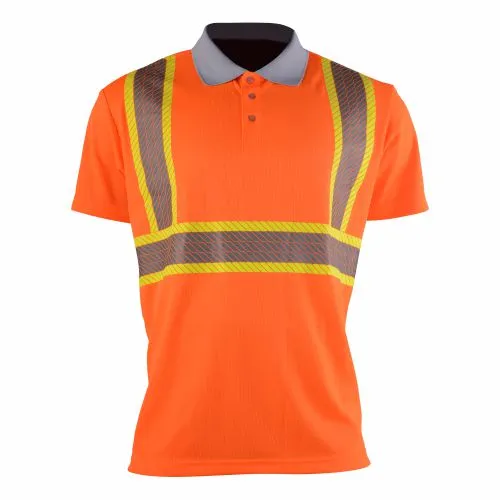
Kachun's recycled two-tone short-sleeve polo shirt uses 100% recycled polyester bird-eye knit. It incorporates moisture-wicking fabric, mesh side inserts, stretch construction, flatlock stitching, and segmented reflective tape. The product is specified to EN ISO 20471 Class 2, ANSI/ISEA-107 Type R/Class 2, and GRS.
This makes wicking birdseye fabric particularly relevant to warm-weather workwear. The bird-eye knit structure can support airflow and moisture management while maintaining a lightweight feel.
For buyers comparing two tone workwear polo shirts, or two tone Hi-Vis polo shirt designs, the key comparison should include:
Fabric composition
Fabric weight
Moisture-wicking performance
Air permeability
Stretch
Reflective tape construction
Washing durability
High-visibility classification
Kachun's recycled shirt and vest range includes recycled bird-eye T-shirts, recycled two-tone polo shirts, recycled tricot safety vests, and other high-visibility shirt and vest designs.
Vests and bodywarmers occupy a middle position between shirts and jackets.
A lightweight safety vest can be worn over an existing uniform, while a bodywarmer can provide thermal insulation without the bulk of a full jacket.
Kachun's recycled tricot safety vest uses 100% recycled polyester wrap knit and includes chest and waist pockets, plus mesh inserts on both sides for additional breathability and stretch. It is specified to EN ISO 20471 Class 2, ANSI/ISEA-107 Type R/Class 2, and GRS.
For colder conditions, Kachun's recycled full-zip insulated bodywarmer uses 100% recycled polyester woven pongee, a water-resistant finish, and quilted 3M Thinsulate insulation. It is specified to EN ISO 20471 Class 2 and GRS.
This means rPET can be used in both lightweight Hi-Vis softshell vest designs and warmer Hi-Vis bodywarmer constructions.
The choice between a vest and jacket should therefore depend on temperature, layering requirements, mobility, and weather exposure rather than recycled content alone.
Trousers complete a coordinated workwear system and are particularly useful when workers require high visibility and weather protection from the waist down.
Kachun's recycled collection includes HI-VIS recycled polyester waterproof two-tone rain trousers. The product range also includes recycled 2-in-1 Oxford waterproof parkas, softshell jackets, bodywarmers, and other garments.
For buyers considering waterproof orange Hi-Vis trousers, fabric construction, waterproofing, reflective-material placement, mobility, and compatibility with the selected jacket should be assessed together.
The main cost-performance principle remains the same: rPET and virgin polyester can both be engineered into functional work trousers, but the final performance depends on fabric construction and garment design.
Waterproofing and breathability should never be treated as inherent properties of polyester itself.
ISO 4920:2012 provides a spray-test method for determining resistance to surface wetting. Importantly, ISO states that this test does not measure water penetration through the fabric.
This distinction matters when comparing a polyester coat waterproof design or a recycled rain jacket.
A fabric can resist surface wetting while still requiring additional construction to prevent water penetration. For waterproof workwear, buyers should therefore consider:
Surface water repellency
Hydrostatic resistance
Membrane performance
Seam sealing
Zipper protection
Hood construction
Breathability
Garment ventilation
These factors apply equally to recycled and virgin polyester.
Performance Area | rPET | Virgin Polyester | What Buyers Should Compare |
Raw-material cost | Often higher or variable | Often competitive | Current market and order volume |
Durability | High potential | High potential | Yarn and fabric construction |
Breathability | High potential | High potential | Knit/weave and membrane |
Moisture management | High potential | High potential | Fabric structure and finishing |
Waterproofing | High potential | High potential | Membrane, coating and seams |
Stretch | Available | Available | Yarn and fabric engineering |
Insulation | Available | Available | Padding or fleece |
Recycled-content value | High | None | Buyer sustainability requirements |
High-visibility use | Suitable | Suitable | Finished garment compliance |
Best application | Sustainable workwear programs | Conventional workwear programs | Project requirements |
The best material choice changes according to the garment.
Workwear Product | When rPET Is Attractive | When Virgin Polyester May Be Preferred |
Jacket | Sustainability-focused outerwear | Cost-focused standard outerwear |
Softshell jacket | Certified recycled performance garment | Established conventional specification |
Polo shirt | Sustainable lightweight workwear | Large-volume standard uniforms |
T-shirt | Recycled-content programs | Lowest-cost basic garments |
Safety vest | Lightweight recycled visibility layer | Conventional high-volume vests |
Bodywarmer | Sustainable insulated workwear | Cost-sensitive winter programs |
Trousers | Coordinated recycled workwear system | Conventional bulk procurement |
For companies looking for custom Hi-Vis polo shirts, for example, recycled polyester can be considered when customers specifically request recycled content. For standard high-volume uniforms where sustainability certification is not a purchasing requirement, virgin polyester may remain economically attractive.
A practical purchasing process should begin with the garment's required performance rather than the fiber label.
First, define the application. A summer polo shirt requires different properties from an insulated winter jacket. A safety vest has different requirements from waterproof trousers.
Second, establish whether recycled content is mandatory, preferred, or optional.
Third, compare complete fabric specifications, including weight, construction, stretch, finishing, membrane technology, and insulation.
Finally, evaluate the supplier's ability to maintain consistent quality in bulk production.
Kachun's product portfolio covers recycled shirts, vests, jackets, softshells, bodywarmers, waterproof parkas, and rain trousers, making it possible to compare different recycled workwear constructions within one product system.
rPET can have a higher or more variable material cost because recycled feedstock requires collection and processing. However, actual garment pricing depends on fabric construction, certification, order quantity, and market conditions.
It can be. Durability depends on fiber quality, yarn construction, fabric density, finishing, and garment manufacturing rather than recycled content alone.
Yes. rPET can be combined with waterproof and breathable TPU membranes, taped seams, waterproof zippers, insulation, and reflective materials. Kachun's recycled winter jacket is one example.
Yes. Kachun's recycled two-tone polo uses 100% recycled polyester bird-eye knit and combines moisture-wicking performance, stretch, mesh ventilation, and reflective tape.
Yes. Kachun's recycled tricot safety vest uses 100% recycled polyester wrap knit with mesh inserts for stretch and breathability and is specified to EN ISO 20471 Class 2 and GRS.
A recycled bodywarmer can combine recycled polyester with insulation while providing a lighter alternative to a full jacket. Kachun's recycled bodywarmer uses recycled polyester pongee and 3M Thinsulate insulation.
rPET and virgin polyester are not simply “good” and “bad” alternatives. Both can be engineered into high-performance workwear, including jackets, softshells, shirts, polo shirts, vests, bodywarmers, and trousers.
The primary difference is the source of the polyester feedstock. rPET offers a stronger recycled-material proposition, while virgin polyester can remain attractive where low initial material cost and established supply are the main priorities.
For buyers sourcing China workwear, the most reliable approach is to compare the complete garment rather than the fiber name alone. A recycled polyester jacket may achieve waterproof and breathable performance through its membrane and construction; a recycled polo may provide moisture management through bird-eye knit and mesh inserts; and a recycled vest or bodywarmer can provide visibility and insulation with different levels of coverage.
The best choice ultimately depends on four factors: cost, required performance, product life, and sustainability objectives. When these factors are evaluated together, buyers can determine whether rPET or virgin polyester provides the better value for each workwear application.
 English
 日本語
日本語 français
 português
 Deutsch
 dansk
dansk Suomi
Suomi Español
 Nederland
 norsk
norsk