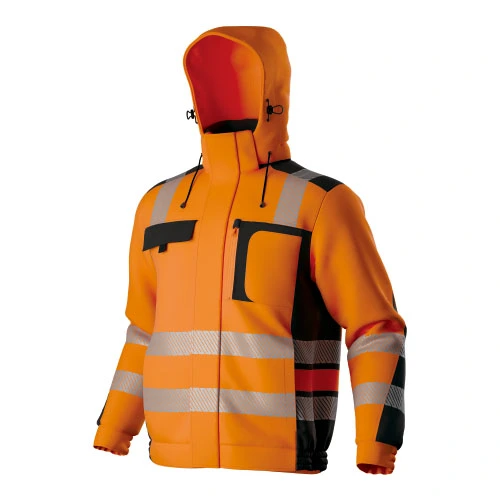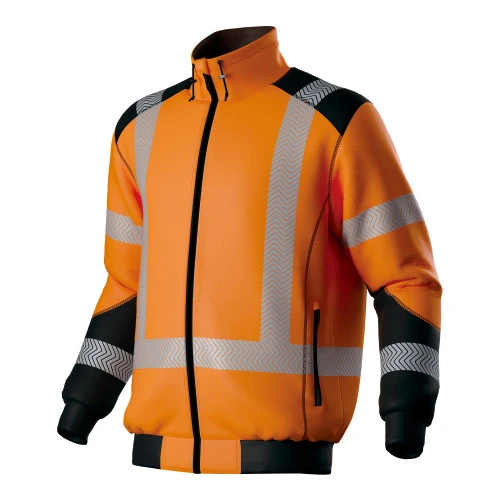
Selecting the right retroreflective trim for industrial workwear involves balancing safety compliance, garment durability, and wearer comfort. For procurement officers and product developers working with a china workwear manufacturer, picking the wrong tape variant can lead to fabric puckering, premature cracking during industrial laundering, or even catastrophic failure in hazardous environments.
Today’s commercial market offers four primary technical modalities for safety trims: Elastic, Segmented, Heat Transfer, and Flame Resistant (FR) options. This guide provides a definitive engineered comparison to help you select the precise material configuration for your corporate uniform lines in 2026.
To help streamline your sourcing process, the matrix below details the structural backing, primary applications, and performance trade-offs of each major reflective tape category.
Reflective Tape Type | Base Substrate / Backing | Application Method | Best Suited For | Key Engineering Benefit | Primary Limitation |
Elastic Reflective Tape | Spandex / Polyester Blend | Sewing | Compression wear, sportswear, flexible active-workwear | Excellent stretch recovery, prevents garment deformation | Higher mechanical friction can wear down micro-beads over time |
Segmented Reflective Tape | Plotter-cut plots on localized carrier | Heat Transfer or Sewn-on backing | High-sweat zone uniforms, modern ergonomic safety vests | Unmatched breathability, superior garment flexibility and comfort | Slightly lower continuous reflection area per linear meter |
Heat Transfer Reflective Tape | Hot-melt adhesive backing (No fabric) | Heat Press ($140^\circ\text{C} - 160^\circ\text{C}$) | Lightweight t-shirts, polo shirts, waterproof rainwear | Zero seam irritation, perfectly flush profile, prevents water leaking | Requires precise temperature control during factory execution |
Flame Resistant (FR) Tape | 100% FR Treated Cotton or Aramid/Nomex | Sewing | Oil & Gas coveralls, electrical arc flash gear, welding jackets | Self-extinguishing, resists structural breakdown at high heat | Stiffer tactile hand-feel, zero elastic elongation |
Standard solid fabric reflective tapes have zero elasticity. When sewn onto modern knitted or stretchable fabrics, they create rigid boundaries that constrict movement and cause the underlying fabric to tear at the seams.
Choosing a high-grade elastic reflective tape ensures that the trim elongates and contracts in perfect synchronization with the garment. This is essential for tactical personnel, outdoor utility workers, and logistics operators who perform continuous bending, reaching, and lifting movements.
Solid bands of reflective tape act as a barrier to heat and vapor, trapping sweat underneath the stripe and causing localized skin irritation in hot climates.
Segmented designs solve this by breaking the retroreflective pattern into parallel rows of small geometric blocks or chevrons. This broken pattern allows the base fabric to breathe freely and vent body heat. Additionally, segmented trims distribute mechanical stress across the garment, preventing the common "cracking" patterns that occur on solid heat-applied stripes after extensive laundering.
Traditional sewn-on trims require needles to puncture the face fabric, creating thousands of microscopic holes. In waterproof apparel like high-visibility rain jackets and windbreakers, these punctures act as entry points for water.
By utilizing fr heat transfer reflective tape, the trim is thermally fused directly onto the textile substrate via a hot-melt adhesive layer. This eliminates thread lines entirely, maintaining the total waterproof integrity of the outer shell while delivering a modern, clean, minimalist corporate aesthetic.
If your workers operate around flash fires, combustible dust, or electrical arcs, standard reflective films cannot be used under any circumstances.
Certified FR reflective tapes utilize heavy-duty, flame-resistant backing material (such as Meta-Aramid or specialized flame-retardant treated cotton). This specialized construction ensures that when exposed to direct flame or extreme radiant heat, the tape will char and self-extinguish rather than melting into a liquid residue that causes severe secondary burns to the skin.
Before locking in your production run with an OEM/ODM workwear solutions partner, ensure your technical specification sheet satisfies the following verification steps:
Laundering Cycle Correlation: Does the tape’s rated wash lifetime (e.g., 25 cycles vs. 50 cycles) match the projected service lifespan of the garment?
Substrate Compatibility: If applying a heat-transfer tape, has the factory performed a cross-hatch peel test on your specific fabric blend to check for long-term adhesion?
Regulatory Alignment: Does the reflective stripe width (typically 50mm) and retroreflection coefficient ($R_A \ge 330 \ \text{cd}\cdot\text{lx}^{-1}\cdot\text{m}^{-2}$) satisfy local regional standards like EN ISO 20471 or ANSI/ISEA 107?
Navigating the intersection of textile physics and safety compliance requires a manufacturing partner with deep engineering expertise. At Kachun Workwear, we maintain a comprehensive, fully vetted inventory of premium elastic, segmented, and certified flame-resistant reflective components.
Whether you need to develop an ergonomic, highly breathable segmented safety vest line or heavy-duty, dual-compliant FR utility coveralls, our specialized production lines ensure zero-defect assembly and total regulatory compliance. For material samples, custom pattern prototyping, or detailed batch pricing, access our official Contact Page or learn more about our operational scale via our comprehensive company profile documentation.
While most segmented reflective tapes are applied via heat transfer for optimal flexibility, specialized versions are available pre-bonded onto heavy-duty fabric backings, allowing them to be sewn securely onto heavy rugged canvas or denim work clothing.
Peeling is almost always caused by improper execution parameters during the factory heat press stage. If the temperature is too low, the dwell time too short, or the line pressure insufficient, the hot-melt adhesive will fail to fully penetrate the textile fibers. Working with an experienced industrial manufacturer eliminates these process variances.
The center silver strip is the active retroreflective element that provides nighttime visibility. The surrounding fluorescent yellow-green or orange fabric borders are designed to maximize daytime and twilight visibility. Two-tone tape is frequently mandated by rail and highway transport regulations to guarantee round-the-clock worker conspicuity.
 English
 日本語
日本語 français
 português
 Deutsch
 dansk
dansk Suomi
Suomi Español
 Nederland
 norsk
norsk